
PROTECT OUR MARINE MAMMALS
SOUTHERN RESIDENT KILLER WHALES
Southern Resident killer whales have important cultural significance for Indigenous Peoples and coastal communities in British Columbia. This population was listed as Endangered under Canada’s Species at Risk Act (SARA) in 2003. The Government of Canada conducted imminent threat assessments in 2018 and 2024 and found that these iconic animals face imminent threats to their survival and recovery. Protecting them requires comprehensive and immediate action. The three primary threats to Southern Resident killer whales are: reduced prey availability and accessibility acoustic and physical disturbance contaminants Canada has laws and regulations in place to address these threats and support the survival and recovery of this population, and there are voluntary measures that you can take as well. Effectively ensuring the survival and recovery of Southern Resident killer whales requires a long-term, collective effort. These measures reflect current science and advice from First Nations, stakeholders, the Indigenous Multi-Nation Group, Indigenous and Multi-Stakeholder Advisory Group, Technical Working Groups, and from public consultations.
The three main threats to Southern Resident killer whales are:
- Declining availability and accessibility of prey
- Acoustic and physical disturbances
- Exposure to harmful contaminants
Canada has established laws and regulations to address these threats and help ensure the species’ survival. In addition to these measures, individuals can also take voluntary actions to support conservation efforts. Long-term protection and recovery of Southern Resident killer whales will require a sustained, collective commitment. These actions are informed by the latest science, and shaped through collaboration with First Nations, the Indigenous Multi-Nation Group, Indigenous and Multi-Stakeholder Advisory Group, Technical Working Groups, stakeholders, and feedback from public consultations.
Area-based fishing closures
The following areas will be closed to salmon fishing by both commercial and recreational harvesters.
- July 15 to October 31 around Swiftsure Bank
- August 1 to October 31 in parts of the Juan de Fuca Strait
- August 1 to September 30 in the mouth of the Fraser River
Fishing closures will also be in effect for recreational and commercial salmon harvesters in the Southern Gulf Islands. Starting May 1, the area surrounding the Southern Gulf Islands will be monitored for Southern Resident killer whale presence by DFO’s Whale Tracking Network and the Vancouver Fraser Port Authority Enhancing Cetacean Habitat and Observation (ECHO) Program, working closely with its local partners. Once Southern Resident killer whales are confirmed to be in the area, their presence will trigger the implementation of salmon fishing closures which will be in place until November 30.
In all Canadian Pacific waters, fishers are also asked to voluntarily stop fishing (do not haul gear) within 1,000 metres (m) of killer whales as a best practice to reduce risk of depredation and to minimize disturbing the animals.
Vessel Restricted Zones
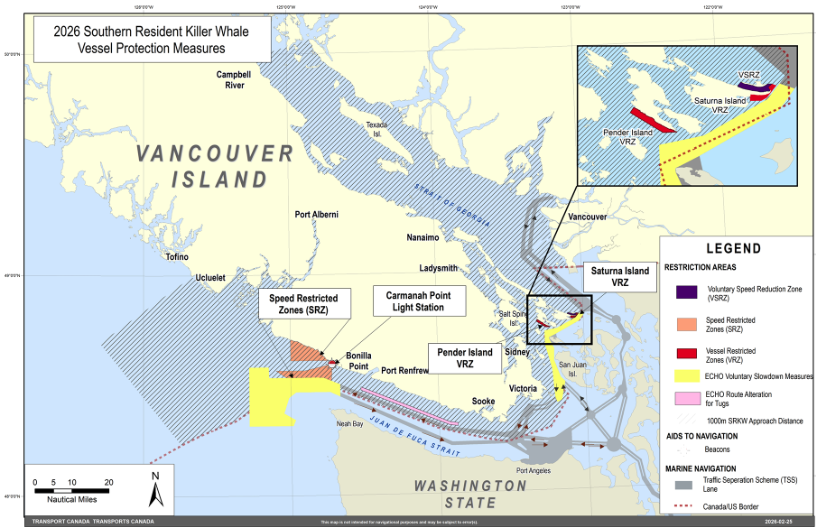
Vessel Restricted Zones, formerly Interim Sanctuary Zones, are in effect from June 1 to November 30 in important areas for Southern Resident killer whales to further reduce acoustic and physical disturbance from vessels.
Vessel traffic (including fishing) will be prohibited in Vessel Restricted Zones off North Pender and Saturna Islands, as per the Interim Order enacted under the Canada Shipping Act. Some exceptions will apply, including emergency situations, vessels engaged in Indigenous food, social and ceremonial fisheries, or Indigenous Peoples exercising existing rights.
There is also a voluntary Speed Reduction Zone in Tumbo Channel from June 1 to November 30, on the north side of Saturna Island. Vessels should reduce speed to no more than 10 knots in this area, when safe to do so.
Speed Restricted Zones
From June 1 until November 30, all vessels are required to slow down to a maximum of 10 knots around Swiftsure Bank:
- in a portion of Subarea 121-1
- in portions of Subareas 121-1, 121-2 and 21-0: near the mouth of the Nitinat River from Carmanah Point to Longitude 125 degrees west
Avoiding whales
Enhanced approach distance for Southern Resident killer whales. Vessels must stay 1,000 m away from Southern Resident killer whales in southern BC coastal waters between Campbell River and just north of Ucluelet until May 31, 2027, as per the Interim Order enacted under the
The Marine Mammal Regulations remain in effect year-round. This requires staying:
200m away from all other killer whales in Pacific Canadian waters
200 m away from all whales, porpoises and dolphins when in resting position or with a calf
100 m away from other whales, porpoises and dolphins
As part of the Government of Canada’s commitment to the protection and recovery of Southern Resident killer whales, Canada proposes to amend the approach distance for Southern Resident killer whales to 1,000 m under the Marine Mammal Regulations. These proposed amendments are based off the best available scientific advice and extensive consultation with First Nations, industry members and stakeholders, and reflect the views published in the 2025 What We Heard Report. Canadians were invited to review and provide comments on the proposed amendments through the Canada Gazette, Part I public comment process from March 7, 2026 to April 21, 2026. Feedback received during this period is currently under review and will help inform the regulatory amendments before they are finalized through publication in the Canada Gazette, Part II.
Be Whale Wise
As well as following Canada’s laws and regulations, there are also voluntary measures that you can take to support the survival of Southern Resident killer whales anytime you’re on or near the water.
- Stop fishing (do not haul gear) within 1,000 m of killer whales
- Reduce speed to less than 7 knots when within 1,000 m of the nearest killer whale
- When safe to do so, turn off echo sounders and fish finders
- If you are too close to a whale, place engine in neutral idle and allow animals to pass.
For more information on the best ways to help whales while on the water, on both sides of the border, please visit: bewhalewise.org